Training & Professional Development
Training philosophy

Industry Project-Based Curriculum
GSERC trainees work on active field studies using the same datasets, software, and workflows deployed to operators. Recent training modules include:
Module 1: Unconventional Reservoir Characterization
PTA/RTA/DCA integration for tight-gas reservoirs. Trainees build Python diagnostic platforms, identify flow regimes, cross-validate permeability and fracture parameters, and forecast EUR using field data from Tunisia.
Module 2: Artificial Lift Selection & Economic Optimization
Design and evaluate ESP, Gas Lift, VPC, and Hybrid GL-ESP systems for high water-cut mature wells. Trainees use PROSPER/PIPESIM and custom Python/VBA tools to size equipment, model flow assurance, and build 10-year economic forecasts.
Module 3: Probabilistic Reserves & PSC Economic Modeling
Monte Carlo simulation for OOIP/STOOIP estimation and NPV/ROI evaluation under Production Sharing Contracts. Trainees develop Excel VBA and Python stochastic models using real Mediterranean and West African field parameters.
Module 4: Machine Learning for Automated Well Log Interpretation
Build ENY apps-style classifiers using Random Forest, XGBoost, and Decision Tree algorithms. Trainees process well log data from the Rio Del Rey Basin, perform feature engineering, and deploy models that achieve >99% accuracy in sub-second execution.
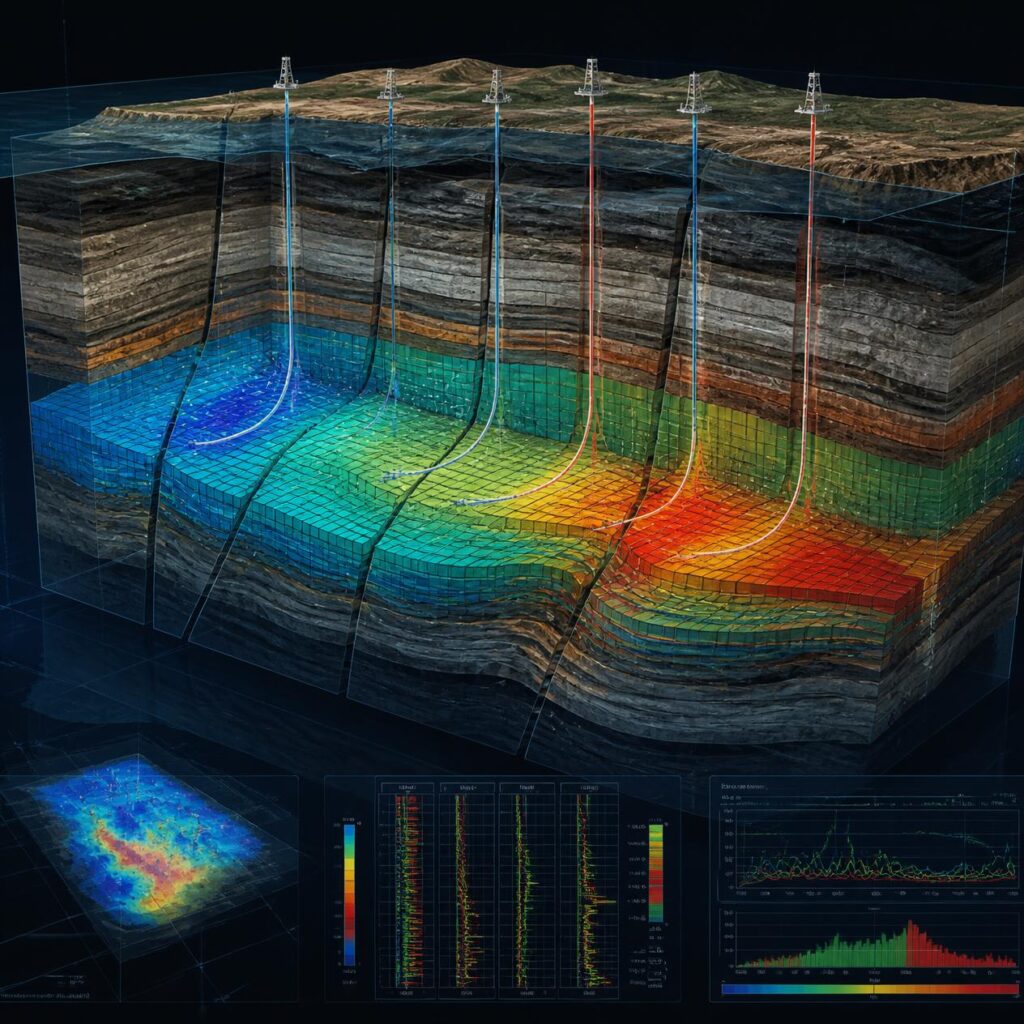
Case study 1: Nechelik Field Reservoir Simulation
Case study 2: Multiphase Waterflood Optimization
Case study 3: Gravity-Driven IMPES Waterflood in Dipping Reservoirs
Case study 4: PTA & Well Performance in Anisotropic Reservoirs
Case study 5: Faulted Reservoir Simulation with Custom Solvers
Internship program — 7 months, full-time
Our flagship program places interns on active research projects where they function as junior petroleum software developers and reservoir engineering research interns.
What interns do:
• Conduct research on unconventional oil & gas reservoirs
• Perform PTA for hydraulically fractured unconventional reservoirs
• Apply RTA techniques using type-curve methods (Fetkovich-Arps, Blasingame, Agarwal-Gardner)
• Develop production forecasting models using modern DCA (Duong, LGM, SEPD, T-model)
• Design and develop Python-based computational applications
Recent spotlight: Ms. Blandine Marcelle Dibondji Mbellas completed a seven-month internship (July 2022 – January 2023) and was recognized for computing, analytical, and teamwork excellence.
Flagship program
Internships: Submit your CV, academic transcripts, and a brief statement of interest to gserc.research.sa@gmail.com
Corporate training: Contact us to discuss customized program design and scheduling.